For those of you who don't know, I was recently in Las Vegas for my birthday (thanks Tori!). As I was sitting in New York, New York eating my steak and drinking my beer, my wife looked at her phone and said "Oh good, there's going to be a full investigation." Since we had been talking about the gigantic map behind her a few moments before, I had no idea what she was talking about. I asked, and she told me the story of Trayvon Martin. I had no idea what she was talking about (self-imposed news blackout, remember?), and after a little bit of googling, I had gotten most of the story.
Short version, Trayvon Martin (forgive me if I'm spelling his first name wrong, I've seen it a couple different ways) was staying at a friends house in an unfamiliar gated neighborhood of Sanford, FL. At some point he went to a corner store for candy. At around 7pm he began walking back to his friends house carrying a soda and a bag of candy in his pocket. George Zimmerman, a local resident and the neighborhood watch captain saw him and called 911, reporting that Martin was acting suspiciously. He reported that Martin was walking slowly, looking at all the houses and appeared to be under the influence of a controlled substance. After being asked by the he dispatcher he described Martin (correctly) as a black teenager and described his clothing. Zimmerman is not black. The dispatcher told Zimmerman that patrol units were on the way and requested that he not follow Martin. Zimmerman responded by saying that there had been multiple break ins in the last couple of months and that "those f*****s" always got away.
When Zimmerman first noticed Martin, he was in his vehicle, and had a legally possessed 9mm pistol in his glove compartment. He exited his vehicle to follow Martin more discretely, and brought the pistol with him. I don't know how he carried the weapon, but I assume either at this side in his strong hand, or tucked into his waistband.
On the dispatch tapes you can hear Zimmerman talk to the dispatcher for a couple minutes before Martin begins to run away from Zimmerman, and pursues him. It ends when Zimmerman looses sight of Martin.
You can listen to the entire dispatch tape here. This is a compilation of all of the 911 calls about this incident and is about 35 minutes long. It contains screams, the sound of a gunshot and multiple expletives. Don't listen to it with your 2 year old standing behind you.
As this was happening, Martin was on the phone to his girlfriend in a different city. He supposedly told her a strange man was following him, and he was afraid. She told him to run, but he told her he would walk fast, but was not going to run. Eventually he did run, and told his girlfriend he thought he had lost Zimmerman, before telling her he saw Zimmerman again. Eventually he told her he was going to confront Zimmerman. While still on the line his girlfriend reported that Martin said "why are you following me?" Zimmerman responded by asking "what are you doing here?" Those questions were followed by the sound of scuffling, and the line went dead.
Other witnesses reported seeing two people struggling, followed by a gunshot. One witness reported hearing someone screaming, and screams for help can be heard in the background of one of the 911 calls, but it's difficult to hear who is yelling what. Martin's family and their lawyer claim it's Martin yelling, Zimmerman claims it's his voice. The voice sounds young and black to me, and it's very possible there was a second, quieter voice in the background, but again, it's very difficult to tell.
When police arrived Martin was dead of a single gunshot wound and Zimmerman stated he shot Martin in self defense. Police conducted an investigation at the scene and did not arrest Zimmerman citing insufficient evidence to support an arrest. Because Martin was dead of a gunshot wound (a homicide in CSI parlance) I'm assuming detectives also conducted an investigation and determined the evidence did not support an arrest.
On Monday, the FBI and federal DOJ announced they would be conducting an investigation into the shooting. On Tuesday, Martin's girlfriend came forward, as far as I can tell, for the first time to talk about her phone conversation with Martin during the incident. To me, this is suspicious. The incident occurred on February 26, and to the best of my knowledge, she came forward on March 20, a full month after the incident. Her statement was released by the lawyer for Martin's family in a recorded deposition. Her statement, coupled with the length of time it took her to come forward and the involvement of the Martin family's lawyer in guiding her testimony during a secret deposition doesn't pass the smell test for me.
Those are the public facts.
Those are ALL of the public facts. Despite the histrionics from the usual suspects (I'm looking at you Gawker, Jezebel, Mother Jones and Huffpo) those facts, read by an impartial observer (the infamous "reasonable man test") don't necessarily equal murder. They don't necessarily equal self-defense, either. They equal ambiguity.
For example, assume this set of facts. After Zimmerman found Martin a second time, Martin decided to confront him. (Remember, he told his girlfriend that he was going to). Martin, being 16 and male, approached Zimmerman aggressively, and demanded to know why Zimmerman was following him. Zimmerman asked Martin who he was, and instead of answering, Martin lunged for the weapon Zimmerman had in his right hand. They struggled for the weapon, and during the struggle Zimmerman realized Martin was younger and stronger than him and was going to be able to wrest possession of the weapon away from him. Fearing for his life (basic rule of self defense, if someone other than a police officer tries to take your weapon, you are allowed to assume they are going to attempt to kill you with it) Zimmerman was able to bring the weapon up and squeeze off a single round. After the round was fired, Martin fell backwards. Realizing the threat was over, Zimmerman did not fire a second round, but instead leaned over him and attempted to provide first aid until police arrived.
Given that set of circumstances, the shooting is completely justified. Zimmerman's judgement for continuing to follow and pursue Martin was poor, but poor judgement is not a criminal offense.
Here's a second set facts to assume. Zimmerman, angry that a series of break ins had occurred, and frustrated that the police appeared unable to prevent them followed Martin, telling police that "those f****s always get away." He followed Martin until feeling cornered, Martin decided to confront Zimmerman. As Martin approached Zimmerman, the undisciplined, poorly trained Zimmerman panicked and brought his weapon up (if you want to assume the utter worst, maybe he thought "I'm gonna bag myself a n****r"). Martin, seeing the strange man who had aggressively followed him now pointing a pistol at him, believed that his life was in imminent danger. In self defense, he grabbed for the weapon and tried to force the muzzle away from his body while screaming for help. Zimmerman panicked (or giggled with glee, depending on how evil you want to paint him) and squeezed off a single round, striking Martin in the chest.
Based on that set of circumstances, you could make a decent case for first degree murder, and a pretty solid manslaughter case.
The truth is, depending on how I flesh out that set of facts, I can clear Zimmerman completely, indict him completely, or create one of a half dozen scenarios somewhere in between.
If you want to know what I actually think happened, it's somewhere in the middle. Martin and Zimmerman were standing toe to toe puffing their chests when either Zimmerman brought up his weapon to detain Martin, or Martin saw his weapon and panicked. (At no point in the 911 call did Zimmerman sound panicked or even particularly excited.) They struggled for possession of the weapon, Martin screamed for help and during the struggle a round was fired, probably accidentally. The round struck Martin in the chest. Martin let go of the weapon and fell backwards, mortally wounded. Zimmerman, shocked and surprised, stepped back and stood by until PD arrived.
Now here's the important part. There are exactly two people in the world who know exactly what happened that night. One of them is dead and one of them will never say another word about it publicly without a lawyer present. Martin's family doesn't know. Zimmerman's friends don't know. Huffington Post, Mother Jones, Gawker and Jezebel, despite their self-righteous smugness, certainly don't know.
I've been working on this post for 2 days. The talkerazzi have been discussing Zimmerman's guilt for several weeks now (at no point have I seen an article, column or post that even suggest Zimmerman might be anything but guilty). What happened that night from start to finish took a grand total of 10 minutes. The final confrontation that ended with Martin's death took less than a minute from the time Martin told his girlfriend he was going to turn and confront Zimmerman to the time that the shot was reported fired. The confrontation happened on a poorly lit street between two people who knew nothing about the other one. Those circumstances are important. Neither Zimmerman or Martin had the benefit of reading what you have just read, the ability to sit back in your comfortable chair with the tasty beverage of your choice and ponder every aspect of the situation. They did not know each other. They did not know what the other one was doing, what they were thinking, and what the other's intentions were. They were both placed in a situation where they were forced to make quick decisions with imperfect information with deadly consequences.
I cannot stress the importance of understanding what both Zimmerman and Martin did not know about the situation they found themselves in. Neither of them knew, or could be reasonably expected to know, very pertinent facts that would have vastly changed the nature and tone of their encounter. We have much, much more information than either of them did, and it's important to judge both of their actions based upon the facts and circumstances as they knew them at the time.
At any point either one of them could have prevented the incident from happening. Zimmerman could have stood 20 yards away and introduced himself to Martin, asking if he could help him. He could have maintained a solid safety cushion by dealing with Martin at a distance, keeping the weapon in reserve in case Martin turned out to have a weapon of his own. Instead of attempting to evade, Martin could have turned to Zimmerman asking if he lived near there, explaining that he was staying with a friend and was lost. But neither chose to do that. Martin turned and ran, making himself look very, very guilty in the process. Zimmerman chose to pursue Martin, making himself look very, very aggressive in the process.
The assumption that of course a white man killed a good, never hurt anyone black kid for no reason at all is a racist and vile assumption. It's just as racist and vile as the "of course the black kid was a criminal up to no good" assumption.
Most people reading this post have never been forced to make a violent decision in a few seconds, with imperfect and incomplete information with potentially life-altering (or life-ending) consequences. It's an art form and an acquired skill, one that very few people have, one that requires training, practice and discipline. Police officers and other first responders spend an inordinate amount of time discussing hypothetical situations, running through the various permutations of what could happen, and what the best response would be over and over again. The point is to already know the best solution before you are put in a situation like this, to train your mind to gather what information you can, and make the best tactically and legally sound decision quickly. Neither Martin or Zimmerman had the benefit of that training.
If Zimmerman acted wrongly he deserves to be forced to answer for his actions. But he also deserves the same assumption of innocence and the fair hearing that every one of us would expect if we were in a similar situation. This concerted effort to railroad him, in absence of any real incriminating facts is despicable. I pray with every fiber of my being that everyone engaged in this social media driven lynch mob is someday put in the exact same situation, including the lynch mob.
I'll bring the rope.
Wednesday, March 21, 2012

Tuesday, March 13, 2012
Politics and relationships
I first became politically aware when I was 10 or 11, around the time of the first gulf war. At the time I was mostly curious about why I kept seeing pictures of tanks, guns and planes on the evening news. Within the space of a month I became conversant (in a simplisitic 10 year old way) on the geo-political situation surrounding Saddam, Iraq, Saudi Arabia and this little country no one had heard of named Kuwait. In case your wondering, at the time I was opposed to that particular war. My opinion has since changed.
As I grew up political awareness became an important part of my identity, and while most of my classmates discussed Michael Jordan's latest feats (or footwear), I could explain, in detail, the political and economic failures of sub-sahara Africa and why, exactly, the Serbians and Bosnians couldn't seem to get along. I never could explain why US soldiers got stuck in the middle of it, but at the time neither could the people who sent them there.
Then I got married. To someone who's political opinions are diametrically opposed to mine. At first I thought we could just agree to disagree and move on, but it has become more complicated than that. I'm finding that many, many aspects of marriage are more complicated than I expected.
I've decided I cannot be politically engaged and married to Tori at the same time, and I really like being married to Tori.
So I've deleted the twitter account I used basically for a political feed reader. My Google Reader subscription list has been pruned significantly, and I have executed my own personal Night of the Long Knives on Facebook. Bookmarks have been deleted, browser histories have been wiped and I'm not sure what I'm going to change my browser's homepage to, but it's not going to be CNN anymore. (Sorry, CNN. It's not you, it's me. Well, that's not exactly true, see, it's like this…)
As for this blog, I don't know what I'm going to do with it. I never intended to make it as political as it has become (for all of 12 posts, don't laugh), I might try to post on other, non-political nerdy things, or I might just lose interest. Time will tell.
That's true of many things right now, time will tell...
Tuesday, March 6, 2012
The Empire Strikes Back
My cousin Jodie recently had surgery on her foot, and while she was recuperating she invited me over to watch Star Wars with her. How could I refuse? So I made the not too longish drive down to her place and watched The Empire Strikes Back. I had a blast, hopefully she did too.
ESB has always been my favorite of the Star Wars movies, and I haven't seen it in a while. Watching it again made me remember why it was my favorite. It's a rich movie, much deeper than any of the other five. This movie is less about the struggle between the Empire and the Rebellion, less of an action movie, and more about the characters developing as their individual struggles become more obvious and the relationships become better defined.
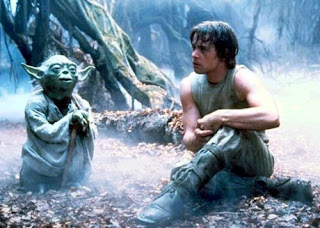 Luke begins to develop his force powers, and learns of the inherent struggle between what he wants to do and what his power, and the responsibility that goes with it, require of him. As Yoda teaches him he learns to control the impatience and impulsiveness viewers saw in A New Hope, and he begins to develop into the disciplined and controlled Jedi that eventually faces and defeats The Emperor in Return of the Jedi. Like all good character developments, though, it's not without struggle, and the lesson ultimately costs him something dear to him.
Han is midway through his transition from loner bad boy to respected leader of the Rebellion, and the romance between Han and Leia is developed and becomes a serious plot line. The ANH Han was selfish, self-absorbed and motivated by two things. Money and self-interest. He was a loner shunning close relationships with anyone except Chewbacca (who let's face it, is the plot equivalent of a dog with opposable thumbs). The ESB Han has developed relationships with the Rebel leadership, and seems genuinely sorry when he breaks the news that he's leaving to deal with Jabba. He risks his life for Leia, and by the end of the movie, calmly accepts his fate encased in carbonite rather than risking Leia's life.
Lastly there's Leia. She is probably the character that changes the least throughout the trilogy, but she clearly has developed a like for Han, if not actual romance. While the ANH Leia was a warrior princess, fighting her enemies wherever she found them, the ESB Leia, while still tough as nails, is much more feminine, allowing herself to be interested in Han and eventually admitting her love for him. She has a better hairdo in this one, too.
This movie also sets up, what for me, is the most interesting secondary character in sci-fi, Yoda.
Yoda is really a stereotypical wizened mentor. He hides in a remote location waiting for the day a young apprentice will arrive that he can train to right the wrongs he was unable to fix himself. Through Luke he seeks redemption for his own failures. Prior to Attack of the Clones and Revenge of the Sith, those failures were only hinted at, but oh how tantalizing those hints were. I spent years dreaming up possible reasons Vader had turned to evil and forced Yoda's flight to Dagobah. In some ways that was one of the things I hated the most about the new trilogy, it took away much of Yoda (and Obi-wan's) mystery and replaced it with a worn out "he did it for love" plot.
Yoda also has one of the best scenes in any sci-fi movie when he first meets Luke on Dagobah.
ESB has always been my favorite of the Star Wars movies, and I haven't seen it in a while. Watching it again made me remember why it was my favorite. It's a rich movie, much deeper than any of the other five. This movie is less about the struggle between the Empire and the Rebellion, less of an action movie, and more about the characters developing as their individual struggles become more obvious and the relationships become better defined.
 Luke begins to develop his force powers, and learns of the inherent struggle between what he wants to do and what his power, and the responsibility that goes with it, require of him. As Yoda teaches him he learns to control the impatience and impulsiveness viewers saw in A New Hope, and he begins to develop into the disciplined and controlled Jedi that eventually faces and defeats The Emperor in Return of the Jedi. Like all good character developments, though, it's not without struggle, and the lesson ultimately costs him something dear to him.
Han is midway through his transition from loner bad boy to respected leader of the Rebellion, and the romance between Han and Leia is developed and becomes a serious plot line. The ANH Han was selfish, self-absorbed and motivated by two things. Money and self-interest. He was a loner shunning close relationships with anyone except Chewbacca (who let's face it, is the plot equivalent of a dog with opposable thumbs). The ESB Han has developed relationships with the Rebel leadership, and seems genuinely sorry when he breaks the news that he's leaving to deal with Jabba. He risks his life for Leia, and by the end of the movie, calmly accepts his fate encased in carbonite rather than risking Leia's life.
Lastly there's Leia. She is probably the character that changes the least throughout the trilogy, but she clearly has developed a like for Han, if not actual romance. While the ANH Leia was a warrior princess, fighting her enemies wherever she found them, the ESB Leia, while still tough as nails, is much more feminine, allowing herself to be interested in Han and eventually admitting her love for him. She has a better hairdo in this one, too.
This movie also sets up, what for me, is the most interesting secondary character in sci-fi, Yoda.
Yoda is really a stereotypical wizened mentor. He hides in a remote location waiting for the day a young apprentice will arrive that he can train to right the wrongs he was unable to fix himself. Through Luke he seeks redemption for his own failures. Prior to Attack of the Clones and Revenge of the Sith, those failures were only hinted at, but oh how tantalizing those hints were. I spent years dreaming up possible reasons Vader had turned to evil and forced Yoda's flight to Dagobah. In some ways that was one of the things I hated the most about the new trilogy, it took away much of Yoda (and Obi-wan's) mystery and replaced it with a worn out "he did it for love" plot.
Yoda also has one of the best scenes in any sci-fi movie when he first meets Luke on Dagobah.
When protect and defend becomes search and destroy
I was poking around the interwebs when I found this gem. The link goes to a Mother Jones article (don't judge me) about Eric Holder's recent statements on targeted killing of US citizens at Northwestern University. Here's the link to his prepared statement posted on the DOJ website.
Anyone who's talked to me about politics for more than 10 minutes has figured out that I'm not a huge fan of the Eric Holder DOJ. I'm a proponent of equal justice for all, and he's not. I'm also a fan of the constitution, another difference between me and him. On this issue, though, he's right.
Speaking at Northwestern University Holder first went over the two legal options we have for dealing with terrorists and terrorism suspects, federal criminal courts and military tribunals. There's not a whole lot of controversy there, and I'm just going to gloss over them. Then he got to the interesting stuff, targeted killings. Over the past decade, the US has engaged in a program of identifying, locating, tracking and killing individuals identified as leaders in terrorist organizations.
It's a long speech, and a pretty good one, laying out the administration's policy on when they may carry out targeted killings. I'm not going to pull quote much from it, but you should take the time to read it fully. Just to clarify, I'm dealing with our treatment of American citizens only. I'm perfectly ok with us killing non-US citizens without warning or concern for their (non-existent) rights.
Speaking specifically about the targeted killings of US citizens abroad Holder said "Let me be clear: an operation using lethal force in a foreign country, targeted against a U.S. citizen who is a senior operational leader of al Qaeda or associated forces, and who is actively engaged in planning to kill Americans, would be lawful at least in the following circumstances: First, the U.S. government has determined, after a thorough and careful review, that the individual poses an imminent threat of violent attack against the United States; second, capture is not feasible; and third, the operation would be conducted in a manner consistent with applicable law of war principles."
This strikes me as a good balance. This policy allows us to kill those that need to be removed from the picture, but only as a last resort. This policy also requires timely congressional notification and regular reports to congress.
For practical reasons, we cannot allow anyone to seek shelter among our enemies abroad while they plan and execute attacks against American citizens and soldiers without fear of reprisal. Simply hiding out in an area too dangerous or remote for the FBI or JSOC to reach you shouldn't act as an immunity from response card.
At the same time, the targeted killing of an American needs to be the last resort. If we can realistically get them any other way and return them to US courts to be tried, we should. I'm very cautious about allowing the government to strip away anyone's rights, especially the due process rights for criminal defendants.
I do want to point out that this is essentially the same policy President Bush had during his two terms, and this was an issue that then-candidate Obama demagogued pretty mercilessly. Candidate Obama changed his position on several Bush-era policies after he took over the hot seat. I'm not saying that as a criticism towards President Obama, but as a reminder that all politics aside, to keep us safe in a dangerous world, sometimes the President needs the freedom to do things we find distasteful, unfair or "icky."
Friday, March 2, 2012
Sluts, whores and bitches
With the country embroiled in a birth control debate, and Georgetown law school student Sandra Fluke claming it was costing her "friends" over $1,000 a year for birth control, Rush Limbaugh decided to weigh in on the fray in his usual caring, sensitive, thoughtful way.
Hahaha, who am I kidding. He called her a slut. Then, just to make sure there was no misunderstanding, he went on to clarify exactly what he meant, hijacking the debate and leaving conservatives in a flaming ruin behind him.
Thanks, Rush.
Later in the show, perhaps realizing that soundbite was going to come back to haunt him, he walked the statement back a bit, but didn't recant it. It didn't matter anyway, the damage was done. The usual suspects were immediately filled with righteous indignation. Calls and petitions were made and circulated demanding a variety of apologies by Rush and sanctions against him for his breach of civility.
Should Rush have said that? No. Was it wrong, hurtful and demeaning? Yes. Was he right to apologize? Yes. Do I actually care? Not really.
The truth is that what Rush said, while wrong, is pretty tame compared to the kinds of things that get tossed at conservatives on a regular basis. Don't believe me? How about Bill Maher calling Sarah Palin a cunt? What? No howls of outrage? Eco-wacko's comparing conservatives to holocaust deniers, have you watched Keith Olbermann's show in the past two years? (Don't sweat it, no one else has either, hence his ratings). Wander over to twitter and check out #breitbartRIP or #breitbart to see the vicious things said about Andrew Breitbart on the day he died. If your curious, check out my twitter feed, I retweeted a dozen or so of the better ones.

Have you watched The Daily Show or The Colbert Report recently? How about Family Guy when Seth MacFarlane is in a political mood. (In fairness to Seth, he posted a very nice tweet expressing sympathy for Breitbart's family on the day he died). All three of those shows are hilarious, top notch comedies, but vicious toward their opposition.
Michelle Malkin and Ann Coulter routinely have some of the most vile racist and sexist slurs I have ever seen or heard (and I've heard a lot) hurled their way by leftists. Check out the Santorum urbandictionary.com entry. No insult intended there, right? Conservatives speaking in public and at state universities are routinely prevented from speaking by organized mobs of leftists, and yet I'm supposed to be outraged that Rush called a 30 year old self-described activist a slut?
Glass houses, stones and all that.
Tuesday, February 14, 2012
Happy Valentines Day
I love you Tori.

I have other things to say, but I will reserve those for the privacy of the ridiculously expensive dinner we have planned for tonight :)
Image Credit to Hugh MacLeod at http://gapingvoid.com/

I have other things to say, but I will reserve those for the privacy of the ridiculously expensive dinner we have planned for tonight :)
Image Credit to Hugh MacLeod at http://gapingvoid.com/
Monday, February 13, 2012
Dr. Strangelove, or how I learned to stop worrying and love the gay
Disclaimer: This post is long, and you need to read it all the way through to get the full point. The title is also a bit deceptive. Again, read the full thing.
So today Washington state joined Connecticut, Iowa, New Hampshire, New York, Massachusetts, Vermont and Washington, DC, in allowing same sex couples to apply for and receive marriage licenses.
As someone who has gone on record in support of California's Prop 8, and against the various legal proceedings to overturn it, I felt like making a long rambling post about exactly how I feel about gay marriage. TL;DR version? I don't actually care all that much.
First off, a quick summary of the conservative opposition to gay marriage. There are basically three groups who are opposed to gay marriage.
The first group are the religious conservatives. This group believes that homosexuality is a choice, is wrong, and should not be officially sanctioned by the state. They also believe that marriage is a sacred union between a man and a woman, sanctioned by God and is one of the holy sacraments. This is also the group that contains the fringe element that believes homosexuality should be a criminal offense. That last part is an extreme fringe, sort of like NAMBLA is an extreme fringe of the gay lobby.
The second group are the social conservatives (the lack of "religious" is an important distinction). This group is less about the inherent right or wrong of gay marriage and more about the needs of society as a whole. This group holds that marriage and the traditional family is less a holy sacrament, and more the basic foundation of society. Husband and wife raise multiple children to be productive law-abiding citizens, who get married and have children, rinse and repeat for a few thousand years. This group looks at men and women as uniquely different, bringing different emotional and psychological qualities into the relationship, and holds that both parts are necessary to raise stable, productive children. There is a fair amount of overlap between the religious cons and the social cons.
The last group is the libertarian conservatives. (There is a difference between libertarians and lib conservatives, don't get them confused). This group doesn't really care who lives with, has sex with, or marries whom. As long as your talking about two consenting adults conforming to basic social norms in public (mostly naked men with cock-rings wandering down a public street in butt-less chaps is a fairly big no-no), they don't really care what you do. The one big quirk with this group is that they care about HOW something is changed, rather than IF it is changed.
I want to make one thing very clear here. With some basic fringe exceptions, none of these groups "hate" gay people. Before you pull out your Westboro Baptist pictures, read that last sentence again, especially the part where I said "fringe exceptions." You can find fringe exceptions to any position. I can show you people that believe you should be able to "abort" your child for one month after birth, or explain how genocide in Africa is the only way to save the planet if you want to argue whose fringe is more crazy.
In case you don't know, I fall into the third category. I really don't care who wants to have sex with whom, modern marriage is a civil agreement regulated by the state for the purpose of taxation anyway. The concept of civil marriage as a union sanctioned by God has been dead for a long time.
Here's an image of a cute kitty to break up this wall of text.

But why did I support Prop 8, you ask? Because I also dislike bullies, and gay marriage supporters have acted like bullies in California. For better or for worse, the people of California have consistently and overwhelmingly said they do not want to be a state that allows gay marriage.
In 1977, California's democratic controlled state legislature easily passed a law banning gay marriage. This bill was signed into law by Gov. Jerry Brown (yes, THAT Gov Jerry Brown). In the late '90's, gay marriage advocates made significant inroads in the CA legislature, and a legislative repeal of the earlier law looked likely.
In 2000, as the marriage wars were getting hot, Prop 22 was placed on the ballot to reaffirm California's opposition to becoming a state that allowed gay marriage. With about 54 percent of eligible voters casting ballots, Prop 22 passed by about a 62-48 margin.
Gay marriage advocates, after being rebuffed at the ballot box, turned to the California Supreme Court, and in March of 2008, the justices ruled on In re Marriage Cases. In Marriage Cases the Supreme Court found a right of marriage in Article 1 Section 7 of the California Constitution. They instructed the State Registrar of Vital Statistics to require that all County Clerks begin to comply with this new law immediately. They also denied a petition for rehearing and a petition for a stay.
In November of 2008, Proposition 8, an amendment to the California constitution was passed by voters. This prop placed an explicit ban on gay marriage into the California constitution, circumventing the state Supreme Court's ruling. This controversial amendment was campaigned on viciously by both sides, with a final result of 52-48 in support in an election that saw anearly 80 percent voter turn out.
Because they couldn't very well argue that a clause in the state constitution violated the state constitution, gay marriage advocates this time turned to the federal judiciary. In August of 2008, federal district court judge Vaughn Walker ruled on Perry v Schwarzenegger (later Perry v. Brown) that Prop 8 violated both the due process and equal protection clauses of the US Constitution. The ruling was affirmed by the 9th Circuit Court of Appeals in San Francisco on February 7, 2012. A petition for Certiorari to the US Supreme court has already been filed, and both sides are waiting to see if the High Court will grant Cert.
I traced the history of gay marriage in California for a reason. There is a 30+ year history of voters and legislatures voting against gay marriage, and a 10 year history of gay marriage advocates circumventing the will of the voters through legal machinations.
Which brings us back to New York and Washington. How you change the laws, especially a law as fundamental to society as how you define marriage and family, is important. It is not hyperbole to say that this is a transformational change of society, and such change should not be made quickly or lightly.
The last time a change this significant, with this much vitriol on both sides was made was Roe v. Wade, and judicial meddling in what should have been an issue of state law guaranteed that the issue would never be settled, but would be fought on in legislatures, courtrooms and bars across the country for almost 40 years now.
New York and Washington did it the right way, by building a coalition of lawmakers who supported their views, and assuming Washington's law survives an electoral challenge in November, both sides will settle down and begin to live and work with the new laws. California did it the wrong way, attempting to ram an unpopular law down an unwilling public's throat, virtually ensuring that the issue will not be settled for a very long time.
It has often been said that democracy is much like making sausage, messy and ugly to watch. That's true, but it also gives closure to both sides and legitimacy to the winning side. (If you haven't figured it out yet, I do think legalized gay marriage in inevitable, it's just a matter of socially liberal teens making it to voting age). That legitimacy is important, because without it, you have the abortion wars, splitting the country down the middle for generations.
The irony, is that by doing this, gay marriage advocates have done their cause enormous harm. The truth is, in 10 years a solid majority of Californians would probably vote to enact gay marriage, and in 20 no one will care about gay marriage (or only an insignificant percentage of the population will). By having used strong-arm and bullying tactics, gay couples will be scarred by the illegitimacy that comes from winning on a technicality. If the US Supreme Court grants Cert to Perry v Brown and reverses the 9th Circuit's ruling, then precedent will have been set that states can ban gay marriage under the federal constitution.
Either way, by taking the quick and easy route, over the slow and patient route, gay marriage advocates have guaranteed that no matter what the Supreme Court rules, this issue will not be settled for at least a decade.
Subscribe to:
Posts (Atom)